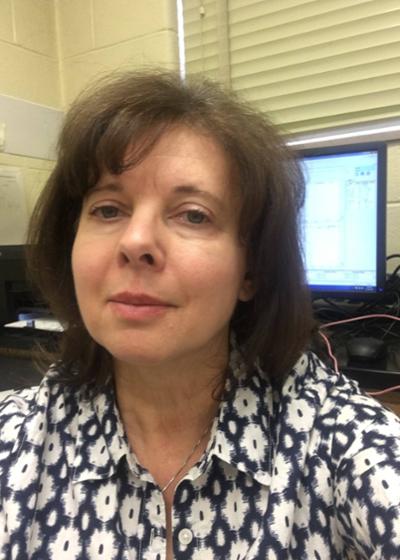
Marina Roginskaya, Ph.D.
Associate Professor (Physical and Biophysical Chemistry)
- roginska@etsu.edu
- 423-439-4367
- 462 Brown Hall
Education and Training
| Year | Degree/Role | Institution |
| 1990 | B.S. Chemisty | Moscow State University |
| 2000 | M.S. Biophysics | University of Rochester |
| 2006 | Ph.D. Biophysics | University of Rochester |
| 2006-2009 | Post-Doctoral Fellow | East Tennessee State University |
Short Bio
I was born in Moscow, USSR in a family of physical chemists. Since early childhood, I was inspired by both my parents and my granny, who was a physicist, by science, history, arts, and reading books. Playing tennis was my passion. Following my parents’ path, I graduated from the Chemistry Department, Moscow State University with honors. After that, I was pursuing PhD in the lab of Chemical Kinetics at MSU, but I did not finish it due to the birth of my son Vlad. In 1996 Vlad and I joined my husband, Yuriy. I started my PhD research in Oakland State University, MI. Two years after that we moved to Rochester, NY, where I started a new PhD program in biophysics. In 2001 our second son, Stanislav, was born, and soon after that we moved to Johnson City, TN, where my husband started a tenure-track position at ETSU, Department of Physics and Astronomy. I finished my PhD in absentia. I graduated from UofR in 2006 with honors and immediately accepted a postdoctoral position in molecular biology and then physiology at ETSU. After that, I was working as a lecturer at the Chemistry Department, ETSU, for 2 years. From 2011, I started my tenure-track position at the Chemistry Department, ETSU as an Assistant Professor. I received my tenure and Associate Professor in 2017. My older son Vlad is an MD and is currently in a residency in radiology. Stanislav also wants to pursue medical career and is planning to take MCAT in the beginning of 2026. My mom lived with us. We also have three lovely cats.
Teaching Philosophy
My major teaching philosophy is based on the principle: students should not learn by heart equations and formulas but understand the principles. While of course some memorization is important, especially at the low-level undergraduate courses, I discourage my students and graduate students from mechanical memorization. It is very important to learn how to learn. This is like learning biking or swimming. Once a person learns it, they can do it forever.
Also, I always emphasize the importance of interacting with students during the classes. Just mere presence at a class gives students nothing. I do my best to teach my students to think critically and to analyze the material.
I am very open to questions and comments during the classes and office hours. Moreover, I am very available by email and very eager to meet with students beyond office hours. I organize zoom meetings and reviews before each midterm and final exams.
Courses Taught
Gen Chem I (CHEM 1110); Gen Chem II (1120); Intro Integrated Lab (CHEM 3611); Intro to Honors Res (CHEM 3008); Seminar and Graduate Seminar (CHEM 4010 and CHEM 5010); Special Topics in Phys Chemistry; Chemical Kinetics (CHEM 5741), Chemical Thermodynamics (CHEM 5710).
Research
My present research interests focus on chemical mechanisms of oxidative damage to DNA under conditions mimicking oxidative stress. Free radical damage to DNA by reactive oxygen species (ROS) overproduced in living organisms due to the effects of ionizing radiation, UV-light, tobacco smoking, and infections has been unequivocally linked to a number of debilitating conditions as cancer, cardiovascular and neurodegenerative diseases, and aging. Therefore, cures for these diseases rely on a better understanding of underlying mechanisms of DNA damage. The aim of my research is to deepen the understanding of chemical mechanisms of reactions of ROS with DNA essential for prediction of long-term biological consequences of these processes and for future elaboration of preventive measures aimed at controlling DNA damage by free radicals.
Our research group has carefully elaborated a set of HPLC-based techniques of quantitative analysis of low-molecular characteristic products of DNA oxidative damage as a well-established, powerful, and convenient method of studying mechanisms of oxidative damage to DNA. In combination with LC-MS, GC-MS, and NMR techniques, these techniques allow for deciphering intermingling mechanisms of DNA damage.
Current Research Projects
- Investigating structures, mechanisms of formation, and further conversions of novel intermediate products of one-electron oxidation of guanine in native highly polymerized DNA and in guanosine (2´-deoxyguanosine) and in short oligomers as models.
- Studies of low-molecular-weight products of highly polymerized DNA irradiated with heavy beams (Ne-22 irradiation) at different doses (a collaborative work with the research group of Dr. Amitava Adhikary, Oakland University, MI).
Selected Publications
- Roginskaya, M., Razskazovskiy, Y. Oxidative DNA Damage and Repair: Mechanisms, Mutations, and Relation to Diseases. Antioxidants 12: 1623 (2023) https://doi.org/10.3390/antiox12081623.
- Razskazovskiy, Y, Campbell, E.B., Cutright, Z.D., Thomas, C. S, Roginskaya, M. One-electron oxidation of guanine derivatives: Detection of 2,5-diaminoimadazolone and novel guanine-guanine cross-links as major end products. Radiat Phys Chem 196: 110099 (2022).
- Thomas, C. S, Pollard, H. C., Razskazovskiy, Y, Roginskaya, M. Sources of 2,5 diaminoimidazolone lesions in DNA damage initiated by hydroxyl radical attack. Free Radic Res 54: 517-524 (2020).
- Razskazovskiy, Y, Tegomoh, M., Roginskaya, M. Association with polyamines and polypeptides increases the relative yield of 2-deoxyribonolactone lesions in radiation-damaged DNA. Radiat Res 192: 324-330 (2019).
- Roginskaya, M., Janson, H., Seneviratne, D. Razskazovskiy, Y. The reactivity of 2,5- diaminoimidazolone base modification towards primary amines: nucleophilic substitution at C5 as a potential source of abasic sites in oxidatively damaged DNA. Res Chem Intermed 43:1543-1555 (2017).
Favorite Thing About ETSU
ETSU is located in a beautiful place in the Appalachian Mountains. It is a very friendly, mostly teaching university with very active research.
Hobbies and Interests
Hiking, walking, cooking, ping-pong, playing piano, knitting, gardening, reading books.